WhatsApp Scam Messages Targeting Guests: What Happened and What We Did

  • Posted on
  • By

Hi everyone, Paul Waldschmidt, CEO of OwnerRez, here.

By now, many of you have heard that some guests are receiving WhatsApp messages that appear to be from their host, property manager, or cleaner. The messages mention the real booking (eg. property, stay dates, sometimes the booking number) and include a link asking the guest to "verify" their credit card or enter it again.

Those messages are scams. They didn't come from you, and they didn't come from us. I want to walk you through what happened, what was and wasn't involved, and what we did about it.

I'd rather you hear the straight story from us than piece it together from forums, subreddits, and other online groups.

This Wasn't a Hack or Break-In

Let me get the most important part out of the way first. Nobody broke into OwnerRez. Nobody got into our servers or databases, nobody cracked a password, and no payment card numbers were exposed. Stored card details never appear on these pages at all, so there was nothing there to take.

We've also found no sign of anyone getting into user accounts or logins.

What was involved is guest contact information that showed up on some guest-facing Rental Agreement pages for current and upcoming stays.

I'll explain exactly what that means below, because the details matter!

So What Actually Happened?

Every booking in OwnerRez has guest-facing pages, like the Rental Agreement the guest signs and the security deposit page. Guests open them from a private link we email them, so they don't have to create an account or remember a password just to sign a Rental Agreement. That's by design, and it's what guests expect.

Between November 19 and 22, someone pieced together those links at scale. They started with public pages (hosted websites and booking widgets), used what they found there to read iCal feeds, and used the iCal feeds to work out the links to each booking's pages. Every step used something that's meant to be reachable without signing in. The problem was how the steps connected together.

Once they had a link, they could open that booking's Rental Agreement page. The Rental Agreement text filled in the guest's name, phone, email and address, the same way it does for the guest so they can review it before signing.

We fixed both ends of that

iCal feeds no longer carry anything that leads to a booking's pages, so the chain from hosted sites to iCal feeds to booking links is broken. And the Rental Agreement page no longer shows a guest's details to anyone who hasn't verified as the guest. Your guests can still open and sign their Rental Agreements as usual.

What showed up on those pages

On most of the affected bookings, the page showed the guest's name, and often their phone number, email and mailing address, along with the property and stay dates. In a very small number of cases, a user's Rental Agreement included custom questions asking for things like a driver's license number or date of birth, and those answers showed too. We're contacting those users individually.

How big was it?

Our database wasn't accessed, and the method only worked through iCal feeds, which list current and upcoming bookings. More than 99% of the guest records we've held in 18 years weren't involved at all. Of the bookings that were affected, the vast majority were upcoming stays and nearly all the rest were guests mid-stay.

Unfortunately, the affected bookings were spread across a lot of accounts, so it's very possible you had one in the group even if you only have a few upcoming stays. About four in ten OwnerRez accounts had at least one booking involved. A guest's own phone number or email showed on about three in ten current and upcoming bookings. (Airbnb and Booking.com often don't pass along a guest's real phone or email in the first place, so those bookings had less to show.)

How Fast We Shut It Down

We found out on Sunday, November 22, when users started reporting the messages their guests were getting. Our sysops and engineering teams jumped on it right away. Within about five hours they had figured out how it was being done, closed off the route the scammers were using, and released a fix to the Rental Agreement pages. They also blocked every address we've tied to the activity.

That was a Sunday afternoon on the weekend before Thanksgiving, and I'm really proud of how fast the team moved!

I'm not going to get into the technical specifics of the fixes (for obvious reasons). What I can tell you is that every route we've found is closed, and we've gone back over the related guest pages to make sure the same trick doesn't work anywhere else.

What We're Doing Now

  • We're emailing every affected user directly. If any of your bookings were involved, you'll get an email from us by Wednesday (Nov 25) with the list of those bookings and what showed on each one.
  • We're giving you wording to send your guests. That email includes a short message you can copy and send to the guests on those bookings.
  • We're handling the ID cases one by one. For the small number of guests whose driver's license number or date of birth may have shown, we're working with each user directly.
  • We're notifying channel partners whose bookings were affected. This one is already done. Those channel partners (Airbnb, Vrbo, Booking.com) were notified within a few hours of our team's notice on Sunday, and they have all replied with acknowledgment of the situation.

If you don't get an email from us, our logs show none of your bookings' pages were opened as part of this.

Things You Might Notice

If an outside calendar reads your OwnerRez iCal feed, it may show each booking removed and added again once. Nothing changed on the bookings themselves.

In the next few days or weeks, the same WhatsApp phishing messages might happen again for the same set of bookings and guests. If a scammer has a guest's phone number, there's nothing preventing them from sending the same WhatsApp message repeatedly, so that very well may happen. That's not a new attack; simply a recycling of the same one.

What You Should Do

You don't need to change anything in your account. The best thing you can do is get ahead of this with your guests:

  1. Send a quick note to guests with upcoming stays letting them know how you take payment, and that any other request for card details is a scam. Our Broadcast tool can send that message to many guests at one time.
  2. If a guest tells you they already got one of these messages, ask them not to click the link or pay anything, and to report the sender in WhatsApp. If they already entered their card details, they should call their card company right away.
  3. Send us screenshots at help@ownerrez.com if you are unsure of something you're seeing.

If You're a Guest

If you got a message asking you to verify your card or make a payment you weren't expecting, don't click and don't pay, even if it mentions your real booking. Contact your host using the phone number or email from your original booking confirmation and ask them directly.

If you booked on a platform like Airbnb, Vrbo, or Booking.com, use that platform's built-in messaging system to contact the host instead of outside methods.

If you already entered card details or paid, call your card company or bank right away.

Your host is the right person to talk to about your booking. OwnerRez is the software your host uses to manage it.

Questions?

If you have questions about your own account, create a ticket in the app or email us at help@ownerrez.com, and we'll answer there.

For general questions, feel free to ask something here, and we'll do our best to answer it, but please don't post guest names or booking details.

We'll keep this blog post updated as anything changes, and thanks for being an OwnerRez customer! 💚

-Paul Waldschmidt
Co-Founder & CEO

92 Comments (add yours)

Paul W
yesterday
OR Team Member Member for 17 years 895 posts

Hi everyone, Paul here again.

I've read every comment (80+ as of this response) and pulled out some questions and answered them directly, plus a short section at the end about the speed of our response.

Your list of affected bookings and guest wording are live now

Did I miss this? "We're giving you wording to send your guests..." (Danny & Careena L)
Is OR going to tell us which guests were affected so we can communicate with them and not every booking i have on file? (Josh E)

Yes. I'm jumping ahead a bit here, but I wanted to lead with this because it is now ready to use and puts you in the driver's seat.

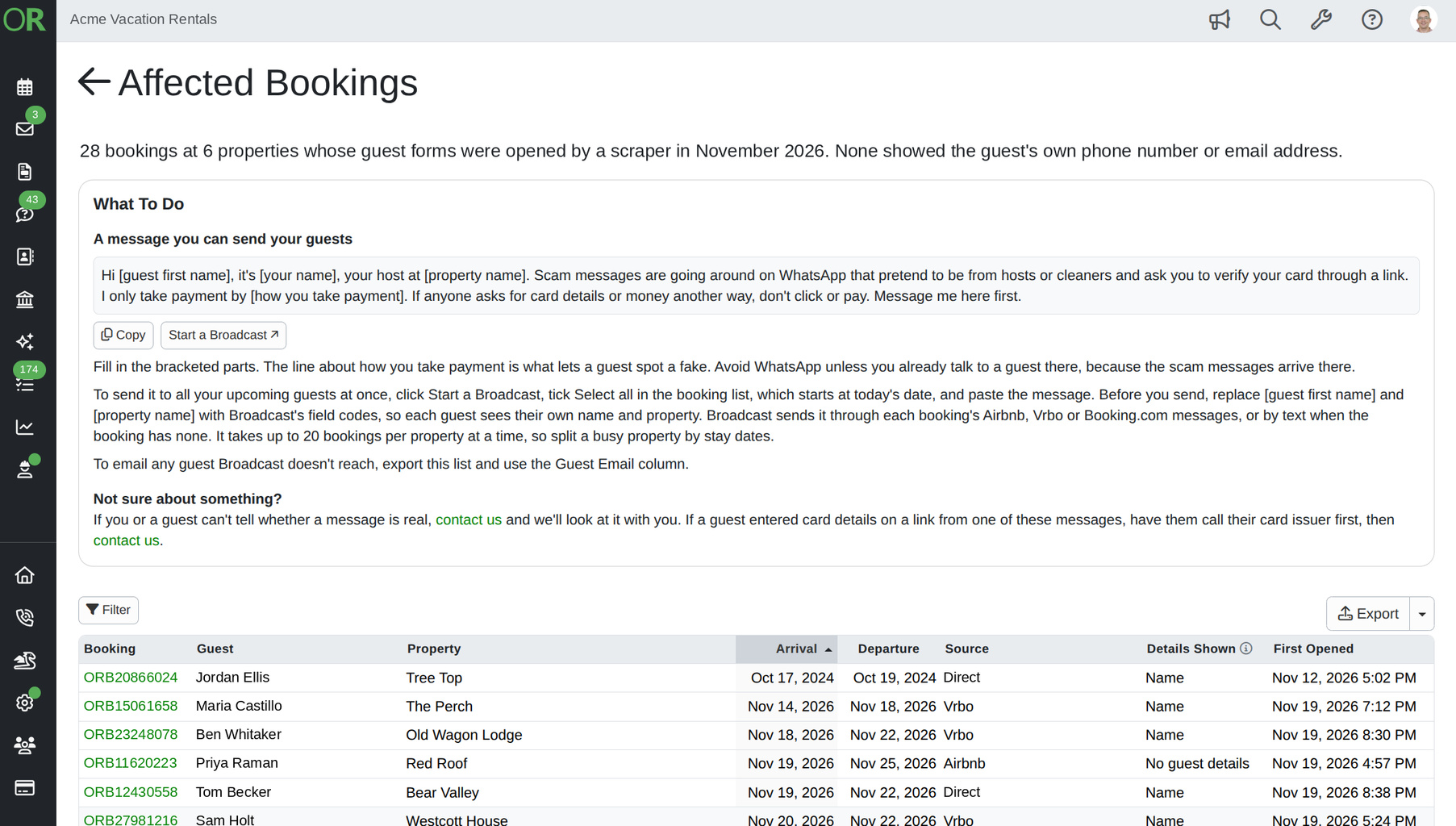
Over the last 24 hours, we built a new Incidents screen in OwnerRez, and it's now live. If any of your bookings were involved, you'll see a yellow bar at the top of My Support with a Review button, and an Incidents tab listing it.

Click into it, and you'll see a list of affected bookings, which guest and property the booking is at, and exactly what showed on each one ("Details Shown" column). You can export the list. There's also a ready-made message for your guests with Copy and Start a Broadcast buttons, and step-by-step instructions for sending it to all your upcoming guests at once.

There is more we plan to do here, but this is the first draft of a beta feature that puts you in the driver's seat when an incident happens, big or small. For years, we've been mass-emailing users about incidents they need to look at - typically minor things - with a cryptic list of IDs or numbers to look up by hand. That is over. From now on, you can see the entire case, which records are affected, and export the data or message guests where applicable.

To be clear, the email blast to users (which will now point you to this screen) is actively being worked on and will likely go out by the end of today, or early Wednesday at the latest, as promised.

Here's the message from that screen if you want it now. It's safe to send to any guest:

Hi [guest first name], it's [your name], your host at [property name]. Scam messages are going around on WhatsApp that pretend to be from hosts or cleaners and ask you to verify your card through a link. I only take payment by [how you take payment]. If anyone asks for card details or money another way, don't click or pay. Message me here first.

The line about how you take payment is what lets a guest spot a fake. Avoid sending this over WhatsApp unless you already talk to that guest there, because that's where the scam messages arrived, and the guest might be confused.

Did these messages come through OwnerRez or my WhatsApp connection in OwnerRez?

I'd love to know whether or not these messages were transmitted over the OR messaging platform or if the bad actors extracted phone number info from the breach and used their own WA account (Harry L)

No. None of these messages went through OwnerRez. The scammers sent them from their own WhatsApp accounts, and BookedDirect traced one to a hijacked WhatsApp Business account. WhatsApp was just the delivery method, because a phone number is a WhatsApp address. Your WhatsApp connection in OwnerRez played no part, so connecting or disconnecting it has no effect.

I don't use iCal / Rental Agreements / a website / I'm API-only, and my guests still got messages

I do not use iCal integrations or WhatsApp with OwnerRez, yet I have already had a guest contact me (Danielle S)
Rental agreements are not enabled on our Airbnb bookings, yet those guests have still been targeted. (David & Alison W)

Two things here.

First, "iCal" in this case means the Calendar Export feature that OwnerRez creates automatically for every property. Whether you've connected it to anything doesn't matter. Cadenza spotted this: those links exist on every property by default. How your channels connect (API or iCal) didn't change anything either. Likewise, every booking has a Rental Agreement page, even when you don't require one, because you can always send one to a guest manually. So not using iCal or Rental Agreements doesn't mean you weren't involved.

Second, not every scam message traces back to us. WhatsApp "reservation hijacking" scams hit travelers across the industry, as Angel saw on their own Europe trip booked mostly through Booking.com.

Cadenza's latest comment gets the mechanism mostly right but not the scale. It wasn't every booking in every account. Pages were opened on about half of current and upcoming bookings, and the Incidents screen shows you exactly which ones. What we show in the Incidents screen isn't a guess or inference. It comes straight from the page requests in our logs. If any of your bookings' pages were opened as part of this, they're listed there. If you have no Incidents tab, or nothing under it, no booking pages were opened.

Is it really shut down? Guests are still getting messages today.

They received one WhatsApp phishing attempt yesterday, and another one today from a different account. (Kal Rucker)
Are you sure this is shut down??? (Teresa J)

Yes. The route was closed on Sunday afternoon, and our logs show no successful access since then. What you're seeing now is the scammers reusing what they already collected from new WhatsApp accounts as the old ones get reported. Mel explained this well. New messages don't mean new exposure. Reporting the sender inside WhatsApp is the fastest way to get those accounts shut down.

Were past guests exposed?

I'd like to know if Owner Rez has any reason to believe that past guests' info was also compromised (Your Hosts)

Almost none. 96% of the affected bookings were upcoming stays, nearly all the rest were guests mid-stay, and well under 1% were past stays. Any of yours that were involved, past or upcoming, are on your Incidents screen.

What about photo IDs?

If we request photo ID and they supplied photo of drivers license, would that information have been seen by the scammers? (Bryan W)

No. ID photos and other uploaded images never showed on these pages. What could show is text a guest typed into a custom question on the Rental Agreement, such as a driver's license number. That happened on a very small number of bookings (a few dozen), and we're working directly with each of those users.

Isn't the 99% figure misleading?

The 99% figure is misleading. It includes past guests who were never at risk. What % of current and upcoming bookings had guest details exposed? (David & Alison W)

Fair point. The 99% is measured against every guest record for all of time. Measured against current and upcoming bookings, the pages were opened on about half of them. A guest's own phone number or email showed on about three in ten. On many of the others, only a name showed, often because Airbnb and Booking.com don't pass along real contact details. The "Details Shown" column on your Incidents screen tells you exactly which is which.

What if a guest clicked the link and paid?

what happens if one of our guests did click the link and paid money? Or entered their details and had these stolen? (Lydia & Mike E)

That payment page belongs to the scammers, not to OwnerRez, you, or any channel, so the card details went straight to them. The guest should call their card issuer right away to report the fraud and dispute the charge.

Broadcast didn't work for me

My Broadcast Tool only successfully sends to bookings made through AirBnB & VRBO. Any bookings thru OwnersRez, fail. (Danny & Careena L)

That part is by design. Broadcast sends through each booking's Airbnb, Vrbo or Booking.com messages. When a booking has none of those, like a direct booking, it sends by text instead of email. To email those guests, export your list from the Incidents screen and use the Guest Email column. Broadcast also takes up to 20 bookings per property at a time, so split a busy property by stay dates. Paul H posted the support doc and webinar if you want the full walkthrough.

We've looked and haven't found a bug in Broadcast. If a send still fails for you (Steve, Tammie, Josh, Lydia & Mike), please open a ticket with an example, and we'll trace it.

Tammie said Rezzy pointed her to triggers instead of Broadcast, and Harry said Rezzy told him this came from Airbnb. Rezzy's answer depends a lot on how the question is asked, so it's possible that happened, but I have not been able to reproduce that on my end. Rezzy answered me correctly about this every time I've tried. Here's what I got when I asked it point blank a few minutes ago:

That's the right answer: Broadcast for current and upcoming bookings, and a trigger if you also want new guests who book from now on to get the warning. If Rezzy told you something different, please open a ticket and include the conversation so we can look at what happened.

Should I report guests who got messages?

Do you want their details logged somewhere so you can check if it is part of the loop you think you've closed? (Competa Escapes)

That is no longer necessary. We have a large amount of screenshots and data, both sent from users and found by our sysops team. However, if you are unsure of anything you are seeing and want to confirm it, send screenshots including the sender's number to help@ownerrez.com along with the booking. Please don't post guest details here.

As an aside... Emil, your reply to Danielle was caught by our spam filter automatically, not by a person. I removed that spam flag, so your reply shows like any other.

Why didn't OwnerRez just email our guests directly?

why can't OR just send an email to every current and future reservation for everyone informing them of the problem? (Jonelle Kop-Agen)
We questioned if OwnerRez should have sent a well scripted email to all the guests on our behalf (Lydia & Mike E)

In 18 years, OwnerRez has never contacted a guest directly. That's on purpose, and we've held to it the whole time. Your guests booked with you, not with us. One of our fundamental principles is: every message the guest receives should come from you and your brand, sent through your setup, and OwnerRez should stay invisible to the guest.

As Mel said, guests don't know who OwnerRez is. An email about their stay from a software company they've never heard of would look exactly like the scam. We considered this early on and decided not to, as it would probably further muddy the waters and spread confusion.

That said, this incident showed a potential new feature. We're looking at an opt-in setting that would let you allow us to send a warning to your guests on your behalf in a moment like this.

About the speed of response

Much has been said, here and in other forums, about how slow our response was, so I wanted to pull the curtain back on that as well.

Misinformation travels faster than facts. In the first hours, the stories going around were that our database was hacked, that card numbers were stolen, that it came through OwnerRez's WhatsApp integration, and that every past guest was exposed. None of those were true. We weren't going to add to that by saying things we'd have to take back, so we made sure we had the facts before we said anything. Answering hurriedly can lead to overstating or understating the issue, both of which are bad.

Scott's point still stands, though: a short "we're aware guests are getting scam messages, warn your guests now" doesn't require knowing the cause. We did post a global announcement in the app Sunday, but in hindsight we should have put a looking-into-it notice on the status page as soon as the first reports came in, to mirror what our team was doing behind the scenes.

Several of you read my Sunday line in the post as us patting ourselves on the back. That's not what I meant. What struck me was how much ground got covered that afternoon. The scammers had spent months probing different public endpoints, looking for a way to piece them together, before running the scrape between November 19 and 22. Our team traced that entire chain and closed it within hours. That's possible because we monitor and log a huge amount of data and use AI heavily to work through it. In the old days, an incident like this could mean weeks of work: taking features offline, bringing in outside experts to comb through code, and slowly piecing together how a few public pages connected. Taking features offline would have meant your bookings, Rental Agreements, and potentially other things stopped working (or were limited) during Thanksgiving week.

By the way, that same approach runs all year, not just in a crisis. For every bug a customer reports to us, we're now finding and fixing about 50 on our own - that's a real stat - many of them in older code written by humans years ago. AI is being used to attack all of us, including the scammers in this case. We're glad that it's working on our side too. I'm grateful for the way our sysops team leveraged those processes during this incident.

One more thing: the Incidents screen is permanent. From now on, whenever we need to tell you about a specific set of your bookings, it will show up there with tools to act on it, not as a plain list of IDs in an email.

-Paul

The Host
yesterday
Member for 1 year 4 posts

WE DO NOT HAVE A BOOKING WEBSITE AND STILL GOT SCAMMED. We were in the initial setup of all the ownerrez settings, with no live website, no messages sent through owner rez, no calendar links created from owner rez , no rental agreements, no API connections to anything other than airbnb listing information. And yet, still received multiple whatsapp phishing attempts yesterday and today. This begs the question how is this not a hacking attempt where data was in fact breached.


This is concerning. 

BlueMtnCabins
yesterday
Member for 10 years 1202 posts

WE DO NOT HAVE A BOOKING WEBSITE AND STILL GOT SCAMMED. We were in the initial setup of all the ownerrez settings, with no live website, no messages sent through owner rez, no calendar links created from owner rez , no rental agreements, no API connections to anything other than airbnb listing information. And yet, still received multiple whatsapp phishing attempts yesterday and today. This begs the question how is this not a hacking attempt where data was in fact breached.


This is concerning. 

by The Host – Nov 24, 2026 6:31 PM (UTC)

One does not have to have a booking website. Or even use OwnerRez. 


Recent hospitality data breaches and reservation-related phishing incidents (2025–2026)

- June 29, 2026 – Hong Kong Cybersecurity Authority (HKCERT): Reported targeted WhatsApp and email phishing campaigns impersonating hotels and Booking.com, using genuine reservation information suspected to originate from previously leaked booking data.

HKPC


- June 17, 2026 – Global hospitality phishing campaign: Bitdefender Labs identified at least six active WhatsApp phishing campaigns across more than 10 countries, impersonating at least eight hospitality brands, including Ramada by Wyndham, SENSEA Retreat, Rihga Hotel Zest Takamatsu and Aminess Style Camping Avalona. Criminals used genuine guest names, reservation details and travel dates. Direct breaches of the impersonated brands were not established.

Bitdefender


- June 2, 2026 – Swiss National Cyber Security Centre: Confirmed that exposed Booking.com reservation data from April 2026 was being exploited in personalized WhatsApp phishing campaigns involving fraudulent refunds. Also documented separate attacks involving compromised hotel reservation management accounts.

BACS


- May 28, 2026 – 350 accommodation providers across 50 countries: Norton researchers identified a widespread reservation-hijacking operation involving hotels, vacation rentals, motels and guesthouses. Criminals used genuine reservation information in WhatsApp, SMS and email phishing messages. Germany, France, the UK, Italy, Spain and the US were among the affected countries. The precise sources of the stolen information were not established in every case.

WIRED


- April 13, 2026 – Booking.com data breach: Booking.com confirmed unauthorized access to customer reservation information, potentially including names, email addresses, telephone numbers, and booking details. Affected customers reported receiving personalized WhatsApp phishing messages. The company reset affected reservation PINs but did not disclose the number of affected customers.

TechCrunch


- March 25, 2026 – Expedia / Hotel GrandBach Kyoto Select, Japan: An investigation confirmed unauthorized access to the hotel's Expedia reservation management account following an employee phishing incident. Guest names, telephone numbers, and stay dates were accessed. Travelers who booked through Expedia and its affiliated websites received fraudulent WhatsApp messages. At least one guest suffered confirmed financial losses. This was a hotel account compromise, not a confirmed breach of Expedia's central infrastructure.

Hotel GrandBach Kyoto Select


- January 21, 2026 – Choice Hotels Japan / Comfort Hotel Tokyo Higashi Nihombashi: Unauthorized access to the hotel's Booking.com extranet account exposed guest names, telephone numbers, countries of residence, reservation numbers and stay dates. Guests subsequently received fraudulent WhatsApp verification requests. Some customers reported making fraudulent credit card payments.

コンフォートホテル〖公式〗


- December 31, 2025 – Daiwa Roynet Hotels, Japan: Confirmed unauthorized access to Booking.com reservation management accounts. Guests of at least three hotels received fraudulent WhatsApp messages directing them to websites designed to steal credit card information. The chain changed Booking.com account passwords across all its properties.

1231îcñ⁄.docx


Broader scale of the problem

The Norton research involving 350 accommodation providers across 50 countries is particularly significant. Earlier research referenced both Booking.com and Cloudbeds, although researchers did not establish that either company's central infrastructure was the source of every incident.

The recurring pattern across these incidents is remarkably similar: criminals obtain legitimate reservation information, impersonate accommodation providers, contact guests via WhatsApp, and request payment or reservation verification.

These documented incidents demonstrate that this is an international hospitality industry problem affecting major OTAs, hotel chains, independent hotels, and vacation rentals, rather than a phenomenon specific to OwnerRez or any particular booking channel.

The list distinguishes confirmed data exposures and account compromises from documented phishing campaigns where the original source of the reservation data remains undetermined.

Christina F
yesterday
Member for 3 years 6 posts

"This is not just an iCal issue.
Had this happen to properties that only have a API connection.


by Flowers Vacation – Nov 23, 2026 10:02 PM (UTC)"

Apparently, Airbnb had a data breach on 17Nov, and millions of traveler records from the Expedia Group (VRBO, Hotels.com) were exposed in early October, after Expedia refused to pay a ransomware demand. These incidents were reported on the n0n ransomware site.  So, it seems to me that this could have originated on those travel sites rather than, or in addition to, OR.


skinorth
yesterday
Member for 3 years 12 posts

I just found out through independent means that Hostaway is affect by the same or similar problem involving WhatsApp phishing messages.  No further details available, but fact, not a rumour.

Emil T
yesterday
Member for 1 year 15 posts

WE DO NOT HAVE A BOOKING WEBSITE AND STILL GOT SCAMMED. We were in the initial setup of all the ownerrez settings, with no live website, no messages sent through owner rez, no calendar links created from owner rez , no rental agreements, no API connections to anything other than airbnb listing information. And yet, still received multiple whatsapp phishing attempts yesterday and today. This begs the question how is this not a hacking attempt where data was in fact breached.

by Matthew M – nov. 24, 2026 5:11 p. m. (UTC)

There goes Thanksgiving…

Annie N
yesterday
Member for 3 years 8 posts

We agree with the majority. We host in Australia. 

I only found out about this issue today by chance. I then immediately read up about it and contacted all future guests manually to warn them. So far the only responses I have got have been thank you for warning us. 

I question the following from OR:

1. Why did you not email hosts with initial guidance as soon as you were aware and before attempting to fix the problem? A blog post is not acceptable.

2. Why did OR not directly broadcast to all future guests for everyone on our behalf as soon as the issue was known? It shouldn't be up to us to do this.

3. Are you sure the issue is fixed and what exactly caused the issue? It seems from other posts you may not be sure

4. What are OR going to do to compensate hosts that have been affected? Given there are going to be a number of very upset guests leading to cancellations, poor reviews and/or compensation requests.

5. Are OR 100% sure its only future guests that are at risk?

6. Is the scam limited to OR or are other PMS providers affected?


Paul W
yesterday
OR Team Member Member for 17 years 895 posts

Hi everyone, Paul here again.

I've read every comment (80+ as of this response) and pulled out some questions and answered them directly, plus a short section at the end about the speed of our response.

Your list of affected bookings and guest wording are live now

Did I miss this? "We're giving you wording to send your guests..." (Danny & Careena L)
Is OR going to tell us which guests were affected so we can communicate with them and not every booking i have on file? (Josh E)

Yes. I'm jumping ahead a bit here, but I wanted to lead with this because it is now ready to use and puts you in the driver's seat.

Over the last 24 hours, we built a new Incidents screen in OwnerRez, and it's now live. If any of your bookings were involved, you'll see a yellow bar at the top of My Support with a Review button, and an Incidents tab listing it.

Click into it, and you'll see a list of affected bookings, which guest and property the booking is at, and exactly what showed on each one ("Details Shown" column). You can export the list. There's also a ready-made message for your guests with Copy and Start a Broadcast buttons, and step-by-step instructions for sending it to all your upcoming guests at once.

There is more we plan to do here, but this is the first draft of a beta feature that puts you in the driver's seat when an incident happens, big or small. For years, we've been mass-emailing users about incidents they need to look at - typically minor things - with a cryptic list of IDs or numbers to look up by hand. That is over. From now on, you can see the entire case, which records are affected, and export the data or message guests where applicable.

To be clear, the email blast to users (which will now point you to this screen) is actively being worked on and will likely go out by the end of today, or early Wednesday at the latest, as promised.

Here's the message from that screen if you want it now. It's safe to send to any guest:

Hi [guest first name], it's [your name], your host at [property name]. Scam messages are going around on WhatsApp that pretend to be from hosts or cleaners and ask you to verify your card through a link. I only take payment by [how you take payment]. If anyone asks for card details or money another way, don't click or pay. Message me here first.

The line about how you take payment is what lets a guest spot a fake. Avoid sending this over WhatsApp unless you already talk to that guest there, because that's where the scam messages arrived, and the guest might be confused.

Did these messages come through OwnerRez or my WhatsApp connection in OwnerRez?

I'd love to know whether or not these messages were transmitted over the OR messaging platform or if the bad actors extracted phone number info from the breach and used their own WA account (Harry L)

No. None of these messages went through OwnerRez. The scammers sent them from their own WhatsApp accounts, and BookedDirect traced one to a hijacked WhatsApp Business account. WhatsApp was just the delivery method, because a phone number is a WhatsApp address. Your WhatsApp connection in OwnerRez played no part, so connecting or disconnecting it has no effect.

I don't use iCal / Rental Agreements / a website / I'm API-only, and my guests still got messages

I do not use iCal integrations or WhatsApp with OwnerRez, yet I have already had a guest contact me (Danielle S)
Rental agreements are not enabled on our Airbnb bookings, yet those guests have still been targeted. (David & Alison W)

Two things here.

First, "iCal" in this case means the Calendar Export feature that OwnerRez creates automatically for every property. Whether you've connected it to anything doesn't matter. Cadenza spotted this: those links exist on every property by default. How your channels connect (API or iCal) didn't change anything either. Likewise, every booking has a Rental Agreement page, even when you don't require one, because you can always send one to a guest manually. So not using iCal or Rental Agreements doesn't mean you weren't involved.

Second, not every scam message traces back to us. WhatsApp "reservation hijacking" scams hit travelers across the industry, as Angel saw on their own Europe trip booked mostly through Booking.com.

Cadenza's latest comment gets the mechanism mostly right but not the scale. It wasn't every booking in every account. Pages were opened on about half of current and upcoming bookings, and the Incidents screen shows you exactly which ones. What we show in the Incidents screen isn't a guess or inference. It comes straight from the page requests in our logs. If any of your bookings' pages were opened as part of this, they're listed there. If you have no Incidents tab, or nothing under it, no booking pages were opened.

Is it really shut down? Guests are still getting messages today.

They received one WhatsApp phishing attempt yesterday, and another one today from a different account. (Kal Rucker)
Are you sure this is shut down??? (Teresa J)

Yes. The route was closed on Sunday afternoon, and our logs show no successful access since then. What you're seeing now is the scammers reusing what they already collected from new WhatsApp accounts as the old ones get reported. Mel explained this well. New messages don't mean new exposure. Reporting the sender inside WhatsApp is the fastest way to get those accounts shut down.

Were past guests exposed?

I'd like to know if Owner Rez has any reason to believe that past guests' info was also compromised (Your Hosts)

Almost none. 96% of the affected bookings were upcoming stays, nearly all the rest were guests mid-stay, and well under 1% were past stays. Any of yours that were involved, past or upcoming, are on your Incidents screen.

What about photo IDs?

If we request photo ID and they supplied photo of drivers license, would that information have been seen by the scammers? (Bryan W)

No. ID photos and other uploaded images never showed on these pages. What could show is text a guest typed into a custom question on the Rental Agreement, such as a driver's license number. That happened on a very small number of bookings (a few dozen), and we're working directly with each of those users.

Isn't the 99% figure misleading?

The 99% figure is misleading. It includes past guests who were never at risk. What % of current and upcoming bookings had guest details exposed? (David & Alison W)

Fair point. The 99% is measured against every guest record for all of time. Measured against current and upcoming bookings, the pages were opened on about half of them. A guest's own phone number or email showed on about three in ten. On many of the others, only a name showed, often because Airbnb and Booking.com don't pass along real contact details. The "Details Shown" column on your Incidents screen tells you exactly which is which.

What if a guest clicked the link and paid?

what happens if one of our guests did click the link and paid money? Or entered their details and had these stolen? (Lydia & Mike E)

That payment page belongs to the scammers, not to OwnerRez, you, or any channel, so the card details went straight to them. The guest should call their card issuer right away to report the fraud and dispute the charge.

Broadcast didn't work for me

My Broadcast Tool only successfully sends to bookings made through AirBnB & VRBO. Any bookings thru OwnersRez, fail. (Danny & Careena L)

That part is by design. Broadcast sends through each booking's Airbnb, Vrbo or Booking.com messages. When a booking has none of those, like a direct booking, it sends by text instead of email. To email those guests, export your list from the Incidents screen and use the Guest Email column. Broadcast also takes up to 20 bookings per property at a time, so split a busy property by stay dates. Paul H posted the support doc and webinar if you want the full walkthrough.

We've looked and haven't found a bug in Broadcast. If a send still fails for you (Steve, Tammie, Josh, Lydia & Mike), please open a ticket with an example, and we'll trace it.

Tammie said Rezzy pointed her to triggers instead of Broadcast, and Harry said Rezzy told him this came from Airbnb. Rezzy's answer depends a lot on how the question is asked, so it's possible that happened, but I have not been able to reproduce that on my end. Rezzy answered me correctly about this every time I've tried. Here's what I got when I asked it point blank a few minutes ago:

That's the right answer: Broadcast for current and upcoming bookings, and a trigger if you also want new guests who book from now on to get the warning. If Rezzy told you something different, please open a ticket and include the conversation so we can look at what happened.

Should I report guests who got messages?

Do you want their details logged somewhere so you can check if it is part of the loop you think you've closed? (Competa Escapes)

That is no longer necessary. We have a large amount of screenshots and data, both sent from users and found by our sysops team. However, if you are unsure of anything you are seeing and want to confirm it, send screenshots including the sender's number to help@ownerrez.com along with the booking. Please don't post guest details here.

As an aside... Emil, your reply to Danielle was caught by our spam filter automatically, not by a person. I removed that spam flag, so your reply shows like any other.

Why didn't OwnerRez just email our guests directly?

why can't OR just send an email to every current and future reservation for everyone informing them of the problem? (Jonelle Kop-Agen)
We questioned if OwnerRez should have sent a well scripted email to all the guests on our behalf (Lydia & Mike E)

In 18 years, OwnerRez has never contacted a guest directly. That's on purpose, and we've held to it the whole time. Your guests booked with you, not with us. One of our fundamental principles is: every message the guest receives should come from you and your brand, sent through your setup, and OwnerRez should stay invisible to the guest.

As Mel said, guests don't know who OwnerRez is. An email about their stay from a software company they've never heard of would look exactly like the scam. We considered this early on and decided not to, as it would probably further muddy the waters and spread confusion.

That said, this incident showed a potential new feature. We're looking at an opt-in setting that would let you allow us to send a warning to your guests on your behalf in a moment like this.

About the speed of response

Much has been said, here and in other forums, about how slow our response was, so I wanted to pull the curtain back on that as well.

Misinformation travels faster than facts. In the first hours, the stories going around were that our database was hacked, that card numbers were stolen, that it came through OwnerRez's WhatsApp integration, and that every past guest was exposed. None of those were true. We weren't going to add to that by saying things we'd have to take back, so we made sure we had the facts before we said anything. Answering hurriedly can lead to overstating or understating the issue, both of which are bad.

Scott's point still stands, though: a short "we're aware guests are getting scam messages, warn your guests now" doesn't require knowing the cause. We did post a global announcement in the app Sunday, but in hindsight we should have put a looking-into-it notice on the status page as soon as the first reports came in, to mirror what our team was doing behind the scenes.

Several of you read my Sunday line in the post as us patting ourselves on the back. That's not what I meant. What struck me was how much ground got covered that afternoon. The scammers had spent months probing different public endpoints, looking for a way to piece them together, before running the scrape between November 19 and 22. Our team traced that entire chain and closed it within hours. That's possible because we monitor and log a huge amount of data and use AI heavily to work through it. In the old days, an incident like this could mean weeks of work: taking features offline, bringing in outside experts to comb through code, and slowly piecing together how a few public pages connected. Taking features offline would have meant your bookings, Rental Agreements, and potentially other things stopped working (or were limited) during Thanksgiving week.

By the way, that same approach runs all year, not just in a crisis. For every bug a customer reports to us, we're now finding and fixing about 50 on our own - that's a real stat - many of them in older code written by humans years ago. AI is being used to attack all of us, including the scammers in this case. We're glad that it's working on our side too. I'm grateful for the way our sysops team leveraged those processes during this incident.

One more thing: the Incidents screen is permanent. From now on, whenever we need to tell you about a specific set of your bookings, it will show up there with tools to act on it, not as a plain list of IDs in an email.

-Paul

Stacey S
yesterday
Member for 6 years 4 posts

Massive easily exploited design flaw not even requiring hacking expertise, if someone can figure out a naming convention for links to obtain our proprietary guest and booking info that easily. And OR has iCal presenting this vulnerability for folks who are not even using or wanting iCal vs using API.  I use API and not iCal. Why was I exposed this way then.Did no one think of security?

communication on this has been abysmal. I only found out about the problem from one of 11 affected guests, and then had to go to Facebook to learn that I've already missed a full day since this began. Then it was on Facebook that I found out this update was posted here, I never received ANY direct communications from OR except an email today that systems were off-line for "planned maintenance" which was a farce - obviously it was to try to do something in response to this massive privacy flaw.

Disgusted by the self-congratulatory and defensive attitude from OR. Be worthy of our trust.


Emil T
yesterday
Member for 1 year 15 posts

How many of my guests current and future have been affected: 79%

Number of times ‘sorry’ or apology appeared in the following message: zero

Hi everyone, Paul here again.

I've read every comment (80+ as of this response) and pulled out some questions and answered them directly, plus a short section at the end about the speed of our response
....


skinorth
yesterday
Member for 3 years 12 posts

There is every reason to express appreciation to OR staff who have expended effort above and beyond the call of duty to resolve a challenging issue. But perhaps taking them out to a nice lunch, rather than clogging up a critical bulletin would be a more appropriate way to do that?

I agree with Staycey S that that was NOT the right place to do that! Yes, OR staff often display not only great technical skills but also perseverance in resolving our issues.  I just wish it did not take, like 2 days to get a response to our support questions.

I just went through the Ownerrez recommended process of using "Broadcast" to inform our potentially affected Guests about this WhatsApp scam message problem.  I found the provided text to be rather simplistic, even basic, so I had to edit and augment it.  OK, I agree this was likely developed in a rush, but, whatever!

So then I followed the suggested procedure as provided by the URL by OR Support.  I hit the "Send" button, and information just literally flies by.  I had 55 Guest bookings in the list.  I thought I noticed some "Error" messages flashing by but it was way to quick to catch them!

After some checking, I determined that Airbnb and Vrbo Guests were successfully sent the Broadcast message.  When I sent an email to OR support about this I was notified by OR support that:

"Broadcast sends via channel messaging or SMS (if you have the SMS premium feature). You'd need to email any guests booked outside of Vrbo/Airbnb/Booking.com if you do not use the SMS feature."

Sorry, but we do not have the "Premium" feature!  Turns out I now have to MANUALLY send emails to our direct booking Guests! Here we have an OR-created problem, and, Guess What? I am on the hook to manually send emails to the as-yet specifically identified Guests who directly booked with us!

I am NOT HAPPY!

Jane H
yesterday
Member for 2 years 2 posts

Ny affected bookings is incomplete. It showed 13 bookings were opened and 8 of those bookings had info revealed. However I heard from guests that were part of the 5 that had bookings opened but not scraped. They received WhatsApp phishing messages as well. Doesn't this suggest all 13 that were opened were scraped?  Help me understand if I'm missing something.

SuzWay Systems
yesterday
Member for 2 years 40 posts
Paul, the logs helped your team trace this once hosts reported it. Have you replayed the Nov. 19–22 activity against the monitoring you have now? If so, when would it have alerted someone compared with the first host report? And who can put out a warning to hosts while the cause is still being investigated?